 Skip-the-line available
 The History and Symbolism of Quinta da Regaleira
How an industrialist's Masonic, Templar, and Dantean interests, combined with an Italian set-designer architect, produced one of Europe's most layered esoteric landscapes.
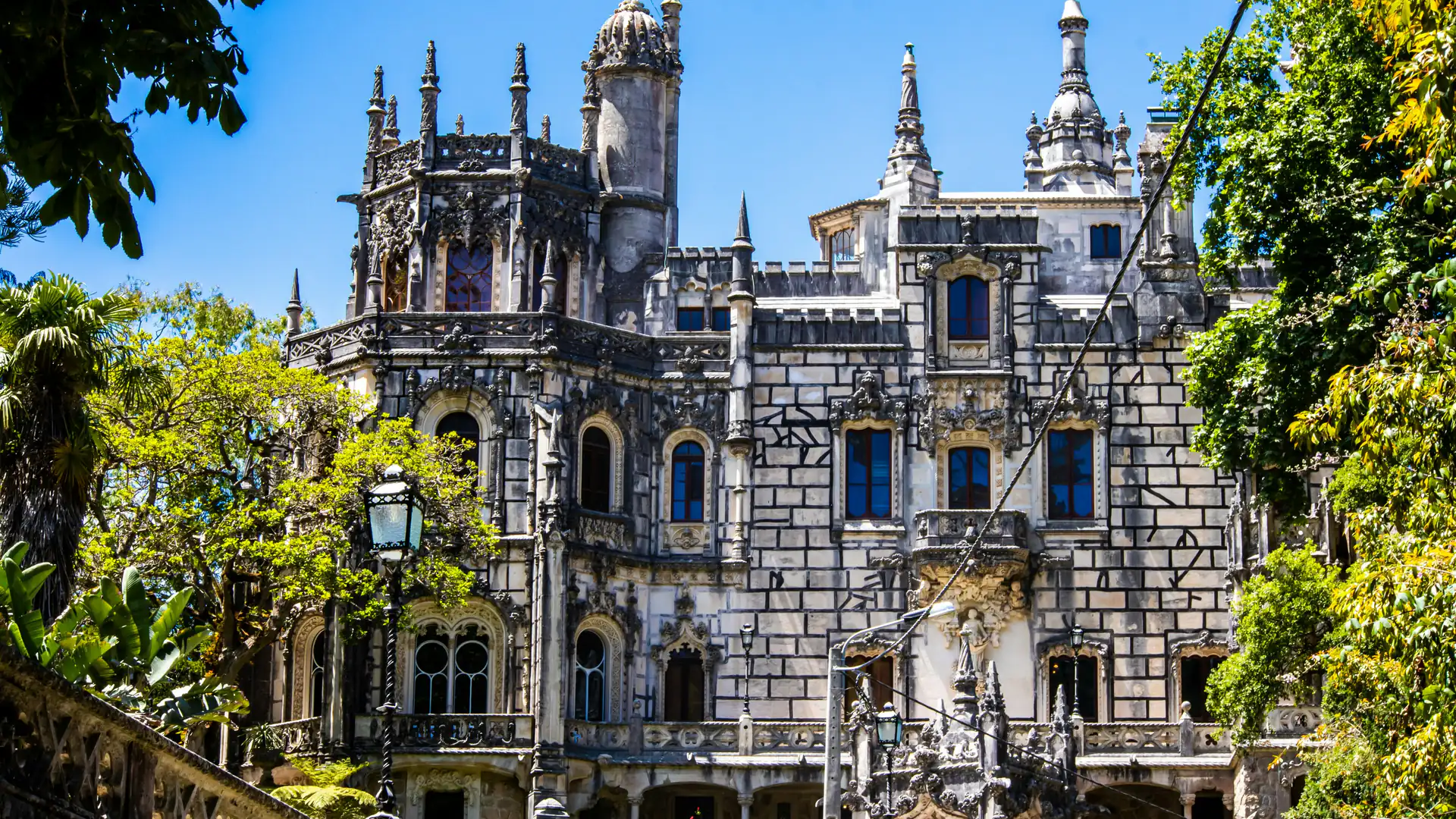
Quinta da Regaleira is one of the most extensively symbolic estates in European landscape architecture, and approaching it without context is to miss most of what is there. The estate was built between 1904 and 1910 by António Augusto Carvalho Monteiro — a Brazilian-born Portuguese industrialist whose private interests included Freemasonry, the Knights Templar tradition, alchemy, Rosicrucianism, and Dante Alighieri's Divine Comedy. He hired the Italian architect and set-designer Luigi Manini to translate those interests into stone, water, and landscape. The result was opened to the general public only in 1997, after the estate passed from private ownership to the Sintra municipality in 1987 and a long restoration. This guide explains who Carvalho Monteiro was, what Manini brought to the design, what the major symbolic systems on the estate refer to, and how the property arrived at its present form.
António Augusto Carvalho Monteiro: The Patron
Carvalho Monteiro was born in Rio de Janeiro in 1848 to a wealthy Portuguese family with extensive Brazilian commercial interests, principally in coffee and precious stones. He studied law at the University of Coimbra, returning to Portugal with a fortune large enough to make him one of the country's richest private individuals by the late 19th century. His public life was relatively quiet — he avoided active politics — but his private collecting was prodigious. He assembled one of the most significant private libraries in Portugal, including a particularly important collection of editions of Dante's Divine Comedy, and developed deep scholarly interests in esoteric traditions including Freemasonry, the symbolic legacy of the Knights Templar, alchemy, and the Rosicrucian movement.
He purchased the Regaleira property in 1893. The estate already had a residential building and gardens from earlier owners, but Carvalho Monteiro demolished much of the existing fabric and commissioned an entirely new ensemble. The choice of architect was telling: rather than a conventional Portuguese palace designer, he hired Luigi Manini, who had spent most of his career as a set-designer at La Scala in Milan and at the Teatro Nacional de São Carlos in Lisbon. The decision aligned with Carvalho Monteiro's intent — Regaleira was never meant to be a residence in the conventional aristocratic sense. It was meant to be a symbolic landscape, a built version of the philosophical journey its owner had spent decades reading about.
Luigi Manini: The Architect as Set-Designer
Luigi Manini was born in 1848 in Crema, Italy, and spent the formative part of his career as a scenographer at Milan's La Scala. He moved to Portugal in 1879 to take a similar position at the Teatro Nacional de São Carlos in Lisbon, where he worked for over two decades before turning increasingly to architecture in the late 1890s. His architectural style was unmistakably theatrical — he treated buildings as compositions designed to produce specific emotional and narrative effects rather than to follow doctrinaire historical revivalism. By the time Carvalho Monteiro hired him for Regaleira, Manini had already worked on other Portuguese projects including the Bussaco Palace in central Portugal, where he developed the dense neo-Manueline vocabulary that would reach its fullest expression at Regaleira.
What Manini brought to Regaleira was the ability to layer architectural languages without producing chaos. The estate combines Manueline (the distinctive late-Gothic Portuguese style associated with maritime exploration and the early-16th-century reign of Manuel I), Gothic, Renaissance, and Egyptian motifs, all coordinated by his set-designer's sense of sightlines and dramatic reveal. The visitor approaches the main palace through a sequence of designed views, descends to the Initiatic Well through a deliberately mysterious garden route, and emerges via the tunnels at the Lago da Cascata in a moment Manini staged as a literal coming-into-the-light. The architectural intelligence is theatrical, but the symbolism it carries is genuine — Manini was working under detailed instruction from Carvalho Monteiro, and the symbolic references throughout the estate reflect his patron's specific philosophical interests rather than any vague Romantic atmosphere.
The Initiatic Well and the Dante Connection
The Initiatic Well is the estate's signature feature and the most explicitly symbolic. It descends 27 metres underground in a spiral staircase of nine landings, and although the well looks like a functional water source it never held water — it was built as a ritual descent. The nine-level structure is widely interpreted as a direct reference to Dante's Divine Comedy, in which Dante descends through nine circles of Hell, ascends through nine terraces of Purgatory, and rises through nine spheres of Paradise. Carvalho Monteiro's library contained an unusually rich Dante collection, and the well's nine-level structure is the most architecturally specific Dantean reference in any garden in Europe.
The well is also read as a Masonic and Rosicrucian initiation chamber. In Masonic ritual, candidates descend symbolically into a chamber of reflection before being raised into the lodge — a ritual descent followed by an ascent into illumination. The Initiatic Well stages exactly this sequence: the visitor descends from the bright garden into darkness, passes through the tunnel network in shadow, and emerges at the Lago da Cascata into sunlight. The Templar cross motif appears at the base of the well, and the carved figures around the well's opening have been variously interpreted as guardians of the threshold in Templar and Masonic traditions. The well's symbolism does not require any one of these readings to be definitive — Carvalho Monteiro deliberately layered multiple traditions, and the well rewards each interpretation in turn.
The Chapel, the Palace, and the Symbolic Garden
The Capela da Santíssima Trindade (Chapel of the Holy Trinity) sits opposite the main palace and carries some of the most explicit Templar and Christian-esoteric symbolism on the estate. Its facade combines Manueline twisted columns with Templar cross motifs, and its mosaic floor features a pentagram surrounded by figures referring to the cardinal virtues and the four evangelists. The interior, when accessible to visitors, contains additional symbolic detail including frescoes referring to the Order of Christ — the Portuguese successor organisation to the Knights Templar, which played a significant role in Portuguese maritime expansion under Henry the Navigator. The chapel was deliberately positioned along an axis with the palace to dramatise the relationship between worldly and spiritual realms.
The garden itself is laid out as a symbolic journey rather than a horticultural showcase. The upper terraces near the palace represent the conscious, ordered world; the lower garden, with its grottoes and the Lago da Cascata, represents the unconscious and the underworld. The route between them passes through the Initiatic Well and the tunnel network, staging the symbolic descent and ascent. Specific plantings — laurels, palms, magnolias — were chosen for their symbolic associations in the traditions Carvalho Monteiro studied, though many of the original specimens have been replaced over the past century. The Tower of Regaleira and the Loggia function as elevated viewpoints from which the symbolic structure of the lower garden becomes legible — an explicit design choice by Manini to allow the initiated visitor to read the landscape as a whole.
From Private Estate to Public Heritage: 1920 to Today
Carvalho Monteiro died in 1920, and the estate passed first to his heirs and subsequently through several private owners during the 20th century. For much of this period Regaleira was not accessible to the general public, and significant elements of its symbolic content remained unknown outside specialist scholarship on Portuguese esoteric traditions. The estate's condition deteriorated through the mid-20th century as the cost of maintaining its elaborate gardens and tunnel network exceeded what private owners could absorb, and by the early 1980s parts of the property were in serious disrepair.
The Sintra municipality acquired Quinta da Regaleira in 1987, and a major restoration began under the management of Fundação Cultursintra (FCS), the foundation established to operate the property. The estate opened to the general public in 1997 — only 29 years ago at time of writing — and has since become one of the most visited cultural sites in Portugal. UNESCO inscribed the wider Cultural Landscape of Sintra on the World Heritage List in 1995, and Regaleira is one of the principal components of that designation. Continued conservation work on the tunnel network, the well structure, and the original plantings is ongoing, and the operator manages the tension between visitor access and preservation of a property whose physical fabric was never designed for two million annual feet.
Frequently asked
Who built Quinta da Regaleira?
The estate in its present form was built between 1904 and 1910 for António Augusto Carvalho Monteiro, designed by the Italian architect Luigi Manini.
Was Carvalho Monteiro a Freemason?
His personal interests included Freemasonry, Templar traditions, alchemy, and Rosicrucianism. Whether he was formally initiated into a Masonic lodge is debated; the estate's symbolism draws on Masonic ritual structure without confirming his membership.
Why are there nine levels in the Initiatic Well?
The nine-level structure is widely interpreted as a reference to Dante's Divine Comedy (nine circles of Hell, nine terraces of Purgatory, nine spheres of Paradise) and to the Masonic ladder of initiation.
Did the well ever contain water?
No. Despite its name, the Initiatic Well was built as a ritual descent and never held water as a functional source.
When did Quinta da Regaleira open to the public?
The estate opened to the general public in 1997, ten years after the Sintra municipality acquired it in 1987 from private ownership.
What is Luigi Manini's background?
Manini was an Italian set-designer who spent most of his career at La Scala in Milan and the Teatro Nacional de São Carlos in Lisbon before turning increasingly to architecture in his later years.
Is Regaleira part of a UNESCO World Heritage site?
Yes. The Cultural Landscape of Sintra was inscribed on the UNESCO World Heritage List in 1995, with Quinta da Regaleira as one of its principal components.
What is the Order of Christ?
The Order of Christ was the Portuguese successor organisation to the Knights Templar after the suppression of the original order in 1312. It played a significant role in Portuguese maritime expansion and is referenced in the chapel's symbolic vocabulary.
Who operates Quinta da Regaleira today?
Fundação Cultursintra (FCS) operates the estate on behalf of the Sintra municipality, which has owned the property since 1987.
Can the symbolism be 'decoded' definitively?
No single decoding is definitive. Carvalho Monteiro deliberately layered multiple esoteric traditions, and serious scholarship on the estate treats its symbolism as a coordinated but multivalent system.