 Skip-the-line available
 The Photographer's Guide to Quinta da Regaleira
Light angles for the Initiatic Well, recommended camera settings for the tunnels, queue-avoidance tactics, and the lesser-known compositions every serious photographer should plan for.
Quinta da Regaleira rewards photographers who plan. The single most famous shot — looking down the descending spiral of the Initiatic Well — depends on a narrow light window, an empty staircase, and a wider-angle lens than most visitors bring, and getting all three to align requires the kind of timing that casual visitors cannot improvise on the day. This guide is for photographers willing to do the homework: when to be at the well, what settings to start with in the tunnels, where the best lesser-known compositions sit, and how to avoid the queues that have made Regaleira photography increasingly difficult in recent peak seasons. All advice is based on practical experience at the estate plus operator information from Fundação Cultursintra (FCS).
The Initiatic Well: Light Windows and Practical Tactics
The Initiatic Well descends 27 metres in a nine-level spiral, and its photographic character changes hour by hour because direct sunlight only reaches deep into the shaft when the sun is at a specific angle relative to the opening. In spring and summer (April to August), the strongest illumination falls roughly between 09:00 and 10:30 in the morning, with a secondary window in the late afternoon around 14:30 to 15:30. In autumn (September to October) the morning window shifts later, closer to 10:00 to 11:30. Outside these windows the well is in deep, even shadow — atmospheric in its own right, but lacking the angled side-light that gives the descending spiral its dimensionality. Check sun position for your specific date using a tool like PhotoPills before committing to a time.
The well's narrow staircase creates a second problem: people. On peak-season days the descent becomes a continuous human chain, and the iconic clean-spiral shot becomes effectively impossible after about 11:00. The only reliable solution is to arrive at the estate for the first entry slot of the day and head directly to the well before doing anything else. The first 30 to 45 minutes after opening are typically the only window when the staircase is clear enough to capture without other visitors. Bring a wider lens than feels necessary — a full-frame equivalent of 16-24mm is the right range for the top-down shot. Tripods are not permitted inside the well in normal visitor operations, so practise hand-holding at slower shutter speeds before you travel.
Tunnel Photography: Exposure, Focus, and Movement
The underground tunnel network connecting the Initiatic Well, the Lago da Cascata, and the Gruta do Oriente runs at a fraction of the ambient light of the upper estate. Practical starting settings for a full-frame camera in the tunnels are ISO 3200 to 6400, aperture f/2.8 to f/4 (wider if your lens permits), shutter 1/30 to 1/60 hand-held with image stabilisation. Crop-sensor and mirrorless users should adjust accordingly. Modern phone cameras with computational night modes perform surprisingly well, but require holding the phone genuinely still for the 2 to 3-second exposure most night modes use — bracing against a tunnel wall is the workable technique.
Focus is the harder problem. The tunnel passages have low contrast, irregular surfaces, and frequent transitions from near-dark to spot-lit areas where small lamps illuminate carved details. Autofocus systems often hunt; manual focus pre-set to about 2 metres is a reliable fallback for the narrow passages. The most common technical mistake is over-cranking ISO past 6400 in pursuit of a faster shutter, then losing the texture of the granite walls to noise. Better to accept a slower shutter and brace properly than to push ISO into the unusable range. The famous spot-lit carvings of mythological figures — the guardian images near the tunnel entrances — reward patient exposure rather than aggressive ISO.
The Chapel, the Palace, and Golden Hour Exteriors
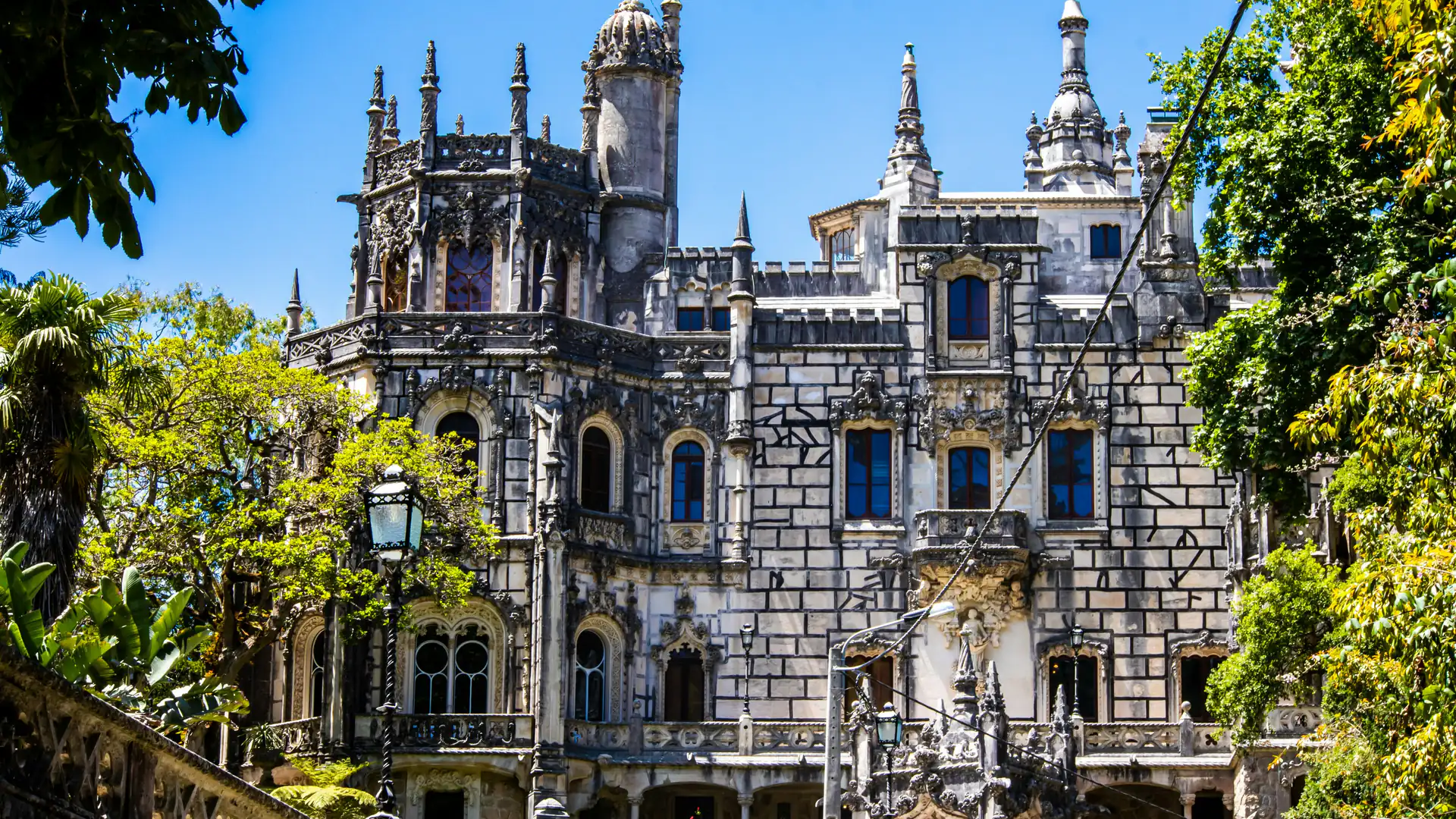
The Chapel (Capela da Santíssima Trindade) carries some of the most photographically rewarding exterior detail on the estate: its facade incorporates Templar cross motifs, Manueline twisted columns, and carved religious-symbolic figures that are most legible in raking morning or late-afternoon light. The interior mosaic floor — visible through the chapel's open door during visitor hours — features a pentagram surrounded by symbolic figures that has become one of the more frequently photographed details of the estate. The Palace itself (Palácio dos Milhões, the main residence building) is best photographed from the western lawn in late afternoon, when the sun lights its principal facade and the towers cast long shadows across the lawns.
Sintra's mist phenomenon is the photographer's hidden asset. On cool mornings between October and March, the Serra de Sintra catches low cloud that drifts across the estate, and the towers of the Palace emerging from soft fog produce images that the dry summer months cannot match. These conditions are unpredictable but most common in the hour after dawn — meaning that if you are staying overnight in Sintra rather than commuting from Lisbon, the first slot of the day can deliver atmospheric conditions that day-trippers from Lisbon usually miss. Pack a lens cloth and a microfibre — Sintra humidity coats front elements within minutes.
Lesser-Known Compositions Worth Planning For
Most visitors photograph the Initiatic Well, the Chapel exterior, and the main palace facade and call it done. The estate rewards a wider search. The Lago da Cascata (Waterfall Lake) at the lower end of the tunnel network features stepping stones across the water leading to a hidden grotto entrance — a composition that benefits from longer exposure if you can stabilise the camera on the surrounding rocks. The Loggia (the elevated covered viewing platform on the upper estate) frames a clean view back toward Pena Palace on the opposite hill — one of the few places in Sintra where you can compose both estates in a single shot. The Tower of Regaleira (a smaller secondary tower near the main palace) offers a 360-degree view from its upper platform that very few day-trippers climb.
The lesser-known shot most worth planning for is the bottom of the Initiatic Well looking up. While the top-down shot is what travel feeds gravitate toward, the inverted composition from the well floor — looking up through the spiral toward the opening — has a more painterly quality, particularly when light is angled into the shaft and produces visible beams through the dust of the ancient air. This shot is best executed when other visitors are still descending the staircase above you, because the human movement adds scale and rhythm to what would otherwise be a static composition. Arrive at the well early, descend ahead of the crowd, and shoot upward as the second wave of visitors begins their descent.
Equipment, Etiquette, and Practical Rules
Equipment that earns its weight at Regaleira: a wide-angle zoom (full-frame 16-35mm equivalent), a fast standard prime (35mm or 50mm at f/1.8 or wider) for the tunnel passages, a microfibre cloth, and a lightweight rain cover. Equipment that often disappoints: full-size tripods (not permitted in the well or inside the tunnels in normal operations), heavy telephoto zooms (the estate is too dense to benefit from long reach), and drones (prohibited within the estate and across the wider Sintra cultural landscape under municipal and operator rules). Compact travel tripods may be permitted in some outdoor areas — confirm with staff on arrival.
Etiquette around the Initiatic Well matters more than at most attractions. The staircase is genuinely narrow, descending and ascending visitors share the same steps, and a photographer who stops in the middle of the spiral to set up a shot can hold up dozens of people behind them. The respectful approach is to descend efficiently with the camera ready, take the shots that work in motion, and step aside onto a landing for any composition that requires stillness. The estate's character — quiet, contemplative, initiatic — is at odds with aggressive tripod-and-flash photography, and visitors who treat the space gently will get better images and better goodwill from the staff. Photography is permitted throughout the estate; commercial photography requires separate authorisation from FCS.
Frequently asked
Are tripods allowed at Quinta da Regaleira?
Full-size tripods are not permitted inside the Initiatic Well or in the tunnel passages. Compact travel tripods may be permitted in outdoor garden areas — confirm with staff on arrival.
What is the best time of day to photograph the Initiatic Well?
Roughly 09:00 to 10:30 in spring and summer, when angled sunlight reaches deep into the shaft. The window shifts later in autumn and winter.
What lens should I bring?
A wide-angle zoom in the 16-35mm full-frame equivalent range is essential for the well's top-down shot. A fast standard prime helps in the tunnels.
Are drones allowed?
No. Drones are prohibited within the Quinta da Regaleira estate and across the broader Sintra cultural landscape under municipal and operator regulations.
Is flash photography permitted?
Flash is generally permitted in outdoor areas but is poor etiquette in the well and tunnels, where it disturbs other visitors and the atmospheric character of the space.
Can I bring professional camera equipment?
Yes for personal use. Commercial photography (paid, published, or promotional work) requires advance authorisation from Fundação Cultursintra.
How long should a photography-focused visit take?
Plan 3.5 to 4 hours to cover the well, tunnels, Chapel, palace exterior, Loggia, and Lago da Cascata at photographer's pace.
What is the best month for atmospheric (misty) photography?
October through March, particularly the cool early mornings when Sintra's Atlantic mist drifts across the Serra.
Are there light restrictions inside the tunnels?
Tunnel lighting is intentionally low and atmospheric. You will need to push ISO and use wide apertures rather than rely on supplemental lighting.
Can I photograph the chapel interior?
The chapel mosaic floor is visible through the open door during visitor hours and can be photographed from the threshold. Access to the interior itself may be restricted at the operator's discretion.